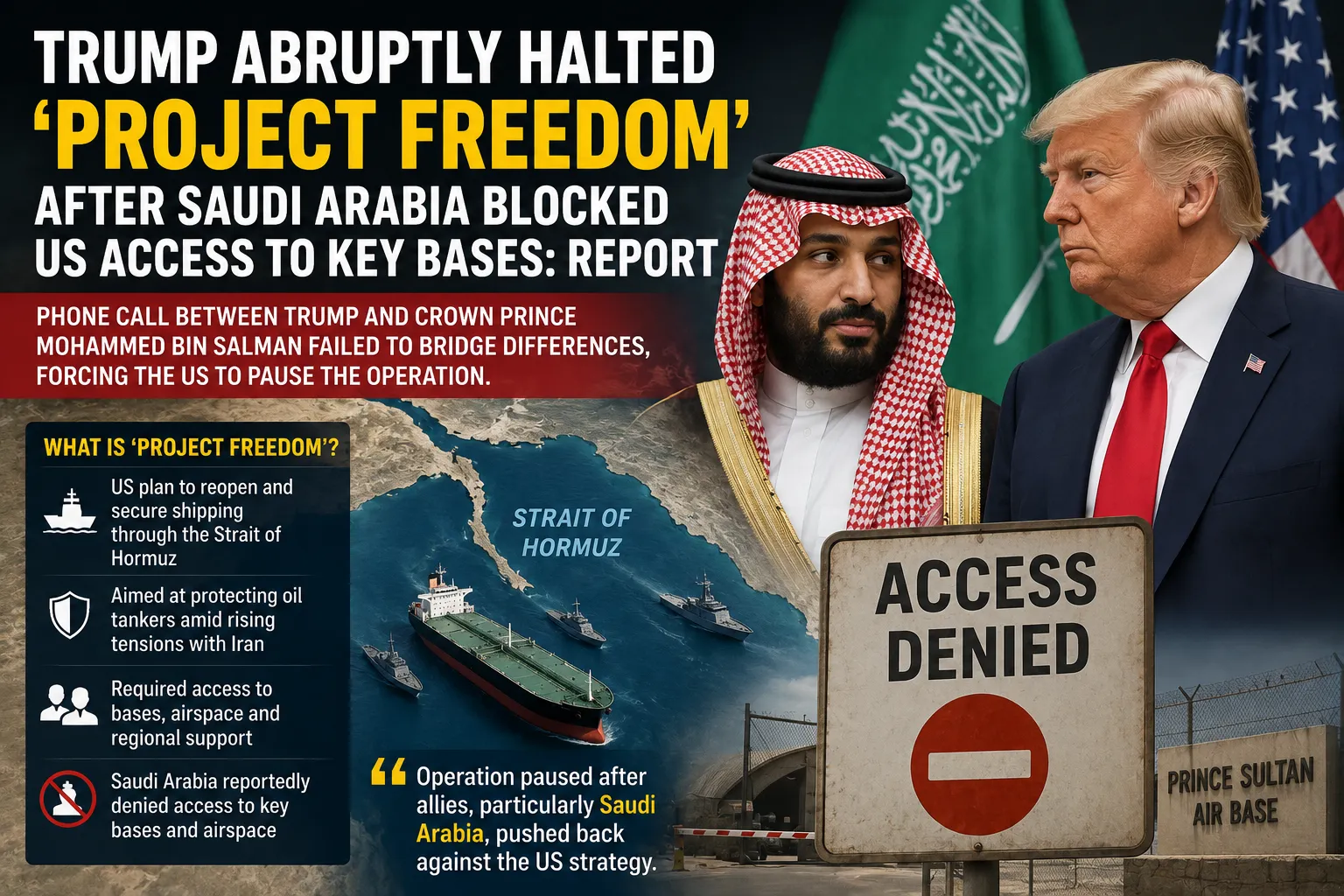
Former US President Donald Trump reportedly paused a proposed military operation called “Project Freedom” after Saudi Arabia and other regional allies objected to the strategy. According to reports, the operation was aimed at reopening and securing shipping movement through the Strait of Hormuz during rising tensions involving Iran and the United States. However, Saudi Arabia reportedly denied access to key military bases and airspace, creating major logistical and diplomatic obstacles for Washington.
The development has drawn global attention because the Strait of Hormuz is one of the world’s most important energy routes. Any instability in this region can affect oil prices, global trade, inflation, and international security. The incident also highlights changing power dynamics in the Middle East, where even close US allies are increasingly pursuing independent strategic decisions.
What Was ‘Project Freedom’?
“Project Freedom” was reportedly a US military initiative designed to secure commercial shipping routes through the Strait of Hormuz. The operation was planned amid growing tensions in West Asia involving Iran and concerns about disruptions to global energy supplies. The United States aimed to ensure safe passage for oil tankers and commercial vessels traveling through the strategic waterway.
The plan likely involved naval escorts, military coordination, and regional security support from Gulf allies. However, the success of such an operation depended heavily on cooperation from countries like Saudi Arabia, which host important US military facilities in the region. Without access to regional bases and airspace, the operation became significantly harder to execute.
The sudden pause in the plan revealed that military power alone is not enough in modern geopolitics. Diplomatic support and regional partnerships remain equally important for any large-scale international operation.
Why the Strait of Hormuz Is So Important
The Strait of Hormuz is one of the world’s most critical maritime routes for oil and energy transportation. A massive share of global crude oil exports passes through this narrow waterway connecting the Persian Gulf to international waters. Countries such as Saudi Arabia, Iraq, Kuwait, Qatar, and the UAE rely heavily on this route for energy exports.
Any disruption in the strait can quickly impact global oil prices and financial markets. Even the fear of military conflict or shipping disruption can trigger economic uncertainty around the world. This is why tensions in the region are closely monitored by governments, investors, and energy companies globally.
The strategic importance of the strait also explains why both the US and regional powers are highly sensitive about security developments there. Maintaining stability in the area remains essential for global economic balance.
Saudi Arabia’s Reported Opposition to the Plan
According to reports, Saudi Arabia was uncomfortable with the proposed US strategy and reportedly refused to provide access to important military facilities, including Prince Sultan Air Base. The kingdom also allegedly restricted access to its airspace, creating major operational challenges for the US military.
Saudi Arabia’s reported resistance reflects growing caution among Gulf countries regarding direct military escalation with Iran. Although the kingdom remains a close American ally, it also faces significant risks if regional conflict intensifies. Saudi oil infrastructure, cities, and economic interests could become targets during any wider confrontation.
The disagreement reportedly continued even after a phone call between Trump and Saudi Crown Prince Mohammed bin Salman. Since the two sides could not fully align on the strategy, the operation was eventually paused.
Why Gulf Countries May Prefer Diplomacy Over Conflict
Many Gulf nations have become increasingly focused on regional stability and economic development. Large-scale military conflict in the Middle East could damage investment flows, disrupt oil exports, and create long-term economic uncertainty.
Countries like Saudi Arabia are currently investing heavily in economic diversification projects, tourism, infrastructure, and global business partnerships. Regional instability could threaten these long-term goals.
There is also growing concern among Gulf states about becoming directly involved in another prolonged regional conflict. Previous tensions in the Middle East have shown how quickly military escalations can spiral into broader instability.
As a result, several regional governments now appear more interested in diplomatic de-escalation and balanced foreign policy strategies instead of direct confrontation.
The US-Iran Rivalry Behind the Crisis
The tensions surrounding “Project Freedom” are closely tied to the long-standing rivalry between the United States and Iran. Relations between the two countries have remained strained for years over nuclear issues, sanctions, military activity, and regional influence.
The Strait of Hormuz often becomes a flashpoint during periods of heightened US-Iran tensions because Iran views the waterway as strategically vital to its national interests. Meanwhile, the United States sees uninterrupted maritime movement as essential for global trade and energy security.
Whenever tensions increase, concerns grow over:
-
Shipping disruptions
-
Naval confrontations
-
Oil supply instability
-
Regional military escalation
This broader geopolitical conflict formed the backdrop for the proposed operation.
How Global Markets Reacted
Global energy and financial markets closely watched developments surrounding the Strait of Hormuz. Since a large portion of the world’s oil supply passes through the route, any military tension in the area can create immediate economic consequences.
Oil prices often rise sharply during periods of Middle East instability because investors fear supply disruptions. Shipping costs and insurance premiums may also increase when security concerns grow in major maritime routes.
The reported pause in “Project Freedom” temporarily eased fears of immediate military escalation. However, uncertainty in the region continues to keep markets cautious.
Global investors understand that even small disruptions in the Strait of Hormuz can affect fuel prices, inflation, and economic growth worldwide.
Changing Dynamics Between the US and Gulf Allies
The incident highlights how relationships between the United States and Gulf countries are evolving. While the US remains an important security partner for Saudi Arabia and other Gulf states, regional governments are increasingly asserting independent foreign policy priorities.
In recent years, Gulf nations have:
-
Expanded ties with China and other global powers
-
Focused more on economic diplomacy
-
Pursued regional reconciliation efforts
-
Reduced dependence on direct military confrontation
This shift reflects a broader transformation in Middle Eastern geopolitics. Gulf countries are balancing traditional alliances with newer strategic interests.
The reported disagreement over “Project Freedom” demonstrates that regional allies may no longer automatically support every American military initiative.
The Importance of Regional Cooperation
One of the biggest lessons from the episode is the importance of regional cooperation in modern military and diplomatic operations. Even powerful countries depend heavily on local partnerships for logistics, intelligence, airspace access, and operational coordination.
Without regional support:
-
Military operations become harder to sustain
-
Diplomatic credibility weakens
-
Strategic goals become more complicated
The situation also shows that international security decisions increasingly require negotiation and consensus-building rather than unilateral action.
Regional powers today have greater influence over how global conflicts and security operations unfold.
What Happens Next?
Although “Project Freedom” has reportedly been paused, tensions in the Middle East remain unresolved. Future developments will likely depend on:
-
US-Iran negotiations
-
Gulf diplomatic strategies
-
Maritime security conditions
-
Global energy market stability
Any new escalation in the region could once again place the Strait of Hormuz at the center of international attention.
At the same time, ongoing diplomatic efforts suggest that many countries want to avoid a large-scale regional conflict that could destabilize energy markets and the global economy.
Conclusion
The reported halt of “Project Freedom” after Saudi Arabia allegedly blocked access to key military bases reveals the complex realities of modern geopolitics. The episode was not simply about a military operation — it reflected shifting alliances, regional caution, economic priorities, and the growing importance of diplomacy in international relations.
The Strait of Hormuz remains one of the world’s most strategically important waterways, making any conflict in the region a matter of global concern. While the United States continues to play a major role in Middle Eastern security, Gulf countries are increasingly shaping regional decisions according to their own economic and political interests.
As tensions continue evolving in West Asia, the incident serves as a reminder that global stability today depends not only on military power, but also on trust, cooperation, diplomacy, and carefully balanced international relationships.
iodailynews.com iodailynews.com iodailynews.com iodailynews.com iodailynews.com iodailynews.com iodailynews.com iodailynews.com iodailynews.com iodailynews.com iodailynews.com iodailynews.com iodailynews.com iodailynews.com iodailynews.com iodailynews.com iodailynews.com iodailynews.com iodailynews.com iodailynews.com iodailynews.com iodailynews.com iodailynews.com iodailynews.com iodailynews.com iodailynews.com iodailynews.com iodailynews.com iodailynews.com iodailynews.com iodailynews.com iodailynews.com iodailynews.com iodailynews.com iodailynews.com iodailynews.com iodailynews.com iodailynews.com iodailynews.com iodailynews.com iodailynews.com iodailynews.com iodailynews.com iodailynews.com iodailynews.com iodailynews.com iodailynews.com iodailynews.com iodailynews.com iodailynews.com iodailynews.com iodailynews.com iodailynews.com iodailynews.com iodailynews.com iodailynews.com iodailynews.com iodailynews.com iodailynews.com iodailynews.com iodailynews.com iodailynews.com iodailynews.com iodailynews.com iodailynews.com iodailynews.com iodailynews.com iodailynews.com iodailynews.com iodailynews.com iodailynews.com iodailynews.com iodailynews.com iodailynews.com iodailynews.com iodailynews.com iodailynews.com iodailynews.com iodailynews.com iodailynews.com iodailynews.com iodailynews.com iodailynews.com iodailynews.com iodailynews.com iodailynews.com iodailynews.com iodailynews.com iodailynews.com iodailynews.com iodailynews.com iodailynews.com iodailynews.com iodailynews.com iodailynews.com iodailynews.com iodailynews.com iodailynews.com iodailynews.com iodailynews.com iodailynews.com iodailynews.com iodailynews.com iodailynews.com iodailynews.com iodailynews.com iodailynews.com iodailynews.com iodailynews.com iodailynews.com iodailynews.com iodailynews.com iodailynews.com iodailynews.com iodailynews.com iodailynews.com iodailynews.com iodailynews.com iodailynews.com iodailynews.com iodailynews.com iodailynews.com iodailynews.com iodailynews.com iodailynews.com iodailynews.com iodailynews.com iodailynews.com iodailynews.com iodailynews.com iodailynews.com iodailynews.com iodailynews.com iodailynews.com iodailynews.com iodailynews.com iodailynews.com iodailynews.com iodailynews.com iodailynews.com iodailynews.com iodailynews.com iodailynews.com iodailynews.com iodailynews.com iodailynews.com iodailynews.com iodailynews.com iodailynews.com iodailynews.com iodailynews.com iodailynews.com iodailynews.com iodailynews.com iodailynews.com iodailynews.com iodailynews.com iodailynews.com iodailynews.com iodailynews.com iodailynews.com iodailynews.com iodailynews.com iodailynews.com iodailynews.com iodailynews.com iodailynews.com