Introduction
Supplying food, fuel, ammunition, and essential equipment to soldiers deployed in high-altitude areas has always been one of the toughest challenges for the Indian Army. Icy winds, thin air, unstable slopes, and limited mobility make traditional logistics methods slow and risky. But in a major technological breakthrough, the Indian Army has successfully deployed an indigenous monorail system at an altitude of 16,000 feet in the Himalayas. This system, installed by the Gajraj Corps, marks a new era in military logistics, significantly improving supply chain efficiency in some of the world’s harshest terrains.
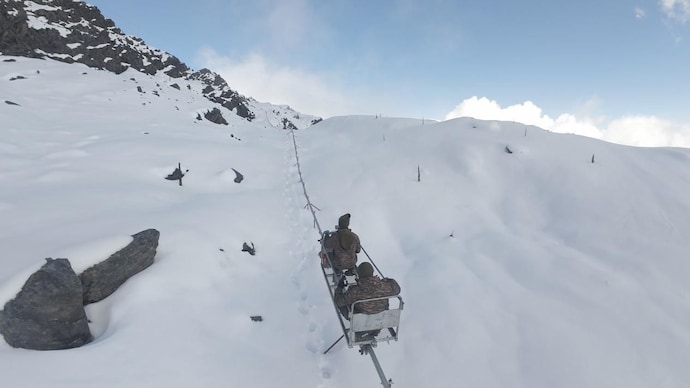
This is the first time such a system has been installed in a high-altitude operational zone. The successful deployment is being viewed as a game-changer for forward posts where weather, altitude, and terrain often cut off supply lines.
A Revolutionary Step for High-Altitude Operations
The newly deployed monorail is specially designed to operate in extreme Himalayan conditions — freezing temperatures, low oxygen levels, heavy snowfall, and unpredictable weather. Conventional vehicles often struggle or fail in such conditions, and helicopter sorties become impossible during long periods of harsh weather.
The monorail solves these problems by enabling continuous movement of supplies, regardless of terrain constraints or weather interruptions. Soldiers stationed at remote posts can now receive food, ammunition, kerosene, winter clothing, medicine, and equipment faster and more reliably.
This innovation is not just convenient — it is strategic. It strengthens India’s operational readiness in sensitive border areas, especially where the Army needs quick and efficient logistics during both peacetime and heightened tensions.
How the Monorail Works
The monorail system runs along a single elevated rail that can carry trolleys loaded with supplies. The structure is lightweight but extremely durable, made from indigenous materials capable of withstanding sub-zero temperatures.
Key features include:
-
High load capacity, suitable for transporting heavy essentials like ammunition boxes and fuel cans
-
Low maintenance design, crucial in remote areas
-
Mechanised movement, which reduces manpower strain
-
Energy efficiency, allowing smooth operation with minimal power
-
Safety mechanisms to prevent derailment in harsh weather
The system is operated by trained personnel who can regulate the trolley movement and monitor the line for safety. This ensures that supplies reach forward posts consistently and with minimal effort.
Why High-Altitude Logistics Is So Difficult
For decades, Indian soldiers in high-altitude areas have depended on:
-
Mule convoys
-
Porters
-
4×4 trucks
-
Ropeways
-
Snow scooters
-
Helicopter supply drops
But each method has limitations.
1. Weather Dependency
Helicopters cannot fly during snowfall, heavy winds, or low visibility — often lasting days or weeks.
2. Terrain Limitations
Vehicles can cover only up to certain points due to ice, broken roads, or steep slopes.
3. Human Fatigue
Porters and mule convoys take long hours or even days to travel and are physically strained at high altitudes.
4. Risk of Delays
Any delay in supplies can severely affect soldiers’ endurance, operations, and safety.
The monorail overcomes these challenges with mechanical reliability and all-weather capability. It reduces the physical burden on soldiers and support teams, ensuring quicker resupply even during harsh winters.
Indigenous Innovation: A Proud Milestone
One of the most remarkable aspects of this project is that it is fully indigenous, designed and developed in India. The system reflects the nation’s growing capabilities in defence innovation and engineering.
The Army worked with Indian engineers to build a solution tailored to Himalayan requirements, something unavailable in off-the-shelf foreign equipment. This aligns with the goals of Atmanirbhar Bharat (self-reliant India), providing advanced solutions without depending on international suppliers.
The success of this monorail may encourage the development of more such logistical tools adapted for high-altitude operations.
Benefits for Soldiers at Forward Posts
The system is expected to make life significantly easier for soldiers deployed in extremely cold and isolated posts. With regular supplies ensured, personnel can focus more on operational duties rather than coordinating physical supply chains.
Major benefits include:
-
Quicker resupply cycles
-
Reduced manpower requirement for transport
-
Higher safety
-
Improved availability of fresh food and essentials
-
Lower physical strain on porters and troops
-
Better preparedness during emergencies or escalations
In inaccessible posts where winter cuts off supply routes for months, this monorail will be a lifeline.
Strategic Importance for India’s Borders
The northern borders of India, especially areas touching Ladakh, Sikkim, Arunachal Pradesh, and parts of Uttarakhand, require uninterrupted logistical access. High-altitude warfare demands massive amounts of supplies, and any disruption can weaken operational capability.
With tensions and strategic competition in the region, reliable supply lines act as a strong deterrent.
The monorail contributes to:
-
Strengthening combat-readiness
-
Faster response during crises
-
Enhanced troop morale
-
Improved sustainability of long-term deployments
This innovation is expected to be replicated across other high-altitude sectors in the coming years.
Safety Upgrades and Future Expansion
Following the successful deployment, the Army is already considering expanding the project to more forward posts. Testing teams have suggested adding:
-
Automated braking systems
-
Remote monitoring sensors
-
Weather-proof covers for trolleys
-
Solar-powered backup energy sources
If scaled up, India may become the first country to use monorails widely for high-altitude military logistics.
A Step Forward in Modern Military Logistics
The monorail system marks a major shift in how India supports its soldiers in the toughest terrains. It reflects modern thinking, technological advancement, and a commitment to soldier welfare. More importantly, it proves that even simple engineering solutions can have enormous strategic impact.
At 16,000 feet, where every step can be exhausting and every supply run can be life-threatening, this monorail is more than just infrastructure — it is a symbol of innovation, resilience, and care.
Conclusion
The deployment of an indigenous monorail system at 16,000 feet by the Indian Army is a remarkable achievement. It solves long-standing logistical challenges, speeds up supply delivery, reduces manpower strain, and strengthens India’s operational capabilities in high-altitude areas.
This pioneering move shows how technology can transform the lives of soldiers and improve national security. As more such systems are installed across the Himalayas, the Army will be better equipped, more efficient, and more prepared to face extreme conditions with confidence.
moviesdebate.com moviesdebate.com moviesdebate.com moviesdebate.com moviesdebate.com moviesdebate.com moviesdebate.com moviesdebate.com moviesdebate.com moviesdebate.com moviesdebate.com moviesdebate.com moviesdebate.com moviesdebate.com moviesdebate.com moviesdebate.com moviesdebate.com moviesdebate.com moviesdebate.com moviesdebate.com moviesdebate.com moviesdebate.com moviesdebate.com moviesdebate.com moviesdebate.com moviesdebate.com moviesdebate.com moviesdebate.com moviesdebate.com moviesdebate.com moviesdebate.com moviesdebate.com moviesdebate.com moviesdebate.com moviesdebate.com moviesdebate.com moviesdebate.com moviesdebate.com moviesdebate.com moviesdebate.com moviesdebate.com moviesdebate.com moviesdebate.com moviesdebate.com moviesdebate.com moviesdebate.com moviesdebate.com moviesdebate.com moviesdebate.com moviesdebate.com moviesdebate.com moviesdebate.com moviesdebate.com moviesdebate.com moviesdebate.com moviesdebate.com moviesdebate.com moviesdebate.com moviesdebate.com moviesdebate.com moviesdebate.com moviesdebate.com moviesdebate.com moviesdebate.com moviesdebate.com moviesdebate.com moviesdebate.com moviesdebate.com moviesdebate.com moviesdebate.com moviesdebate.com moviesdebate.com moviesdebate.com moviesdebate.com moviesdebate.com moviesdebate.com moviesdebate.com moviesdebate.com moviesdebate.com moviesdebate.com moviesdebate.com moviesdebate.com moviesdebate.com moviesdebate.com moviesdebate.com moviesdebate.com moviesdebate.com moviesdebate.com moviesdebate.com moviesdebate.com moviesdebate.com moviesdebate.com moviesdebate.com moviesdebate.com moviesdebate.com moviesdebate.com moviesdebate.com moviesdebate.com moviesdebate.com moviesdebate.com moviesdebate.com moviesdebate.com moviesdebate.com moviesdebate.com moviesdebate.com moviesdebate.com moviesdebate.com moviesdebate.com moviesdebate.com moviesdebate.com moviesdebate.com moviesdebate.com moviesdebate.com moviesdebate.com moviesdebate.com moviesdebate.com moviesdebate.com moviesdebate.com moviesdebate.com moviesdebate.com moviesdebate.com moviesdebate.com moviesdebate.com moviesdebate.com moviesdebate.com moviesdebate.com moviesdebate.com moviesdebate.com moviesdebate.com moviesdebate.com moviesdebate.com moviesdebate.com moviesdebate.com moviesdebate.com moviesdebate.com moviesdebate.com moviesdebate.com moviesdebate.com moviesdebate.com moviesdebate.com moviesdebate.com moviesdebate.com moviesdebate.com moviesdebate.com moviesdebate.com moviesdebate.com moviesdebate.com moviesdebate.com moviesdebate.com moviesdebate.com moviesdebate.com moviesdebate.com moviesdebate.com moviesdebate.com moviesdebate.com moviesdebate.com moviesdebate.com moviesdebate.com moviesdebate.com moviesdebate.com moviesdebate.com moviesdebate.com moviesdebate.com moviesdebate.com moviesdebate.com moviesdebate.com moviesdebate.com